Assignment: Forces Acting On Objects 6.8B Assignment

Created by Pamela P on

8 activities: 8 games

88 min

Activity 1: Simulation Game. Estimated duration: 10 min

Projectile Motion - Drag

Take a deeper look at the effects of air resistance when firing a projectile from a cannon. Determine which factors influence the drag force. Adjust the drag coefficient and see the projectile change shape. Control the mass and diameter of the projectile, and set the altitude. Watch the velocity and drag force in real time! Note: Students will automatically move through this simulation after 10 minutes of playtime.
Ratings

Teacher Ratings (2) 3.0 stars.

Student Ratings (1106) 3.2 stars.
Activity 2: Simulation Game. Estimated duration: 10 min

Projectile Motion - Vectors

Shoot a cannon and see how the velocity, acceleration, and force vectors change throughout the flight. Adjust the cannonball's diameter and mass, and control the cannon's height, angle, and initial speed. Design your own experiments and collect data. Turn on air resistance, and discover how the drag force relates to the motion of the projectile. Note: Students will automatically move through this simulation after 10 minutes of playtime.

Ratings

Teacher Ratings (3) 2.7 stars.

Student Ratings (1394) 3.3 stars.

Activity 3: Simulation Game. Estimated duration: 10 min

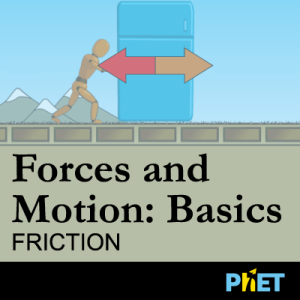
Forces and Motion: Basics - Friction

Explore the forces at work when friction is present. Push against various objects, such as person or refrigerator, or stack multiple objects. Adjust the amount of friction, and create an applied force to overcome it. Find the mass of the mystery object. Note: Students will automatically move through this simulation after 10 minutes of playtime.

Ratings

Teacher Ratings (27) 3.4 stars.

Student Ratings (9473) 3.2 stars.

Activity 4: Simulation Game. Estimated duration: 10 min

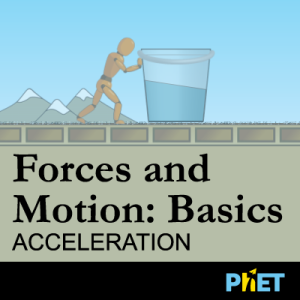
Forces and Motion: Basics - Acceleration

Take a deeper look at the forces in the system as you push against objects, such as a crate, refrigerator, or person. Create an applied force to overcome friction. Measure the speed and acceleration of the object as it moves. Note: Students will automatically move through this simulation after 10 minutes of playtime.

Ratings

Teacher Ratings (41) 3.4 stars.

Student Ratings (8764) 3.3 stars.

Activity 5: Simulation Game. Estimated duration: 10 min

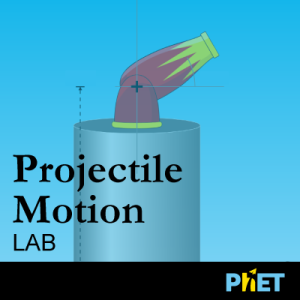
Projectile Motion - Lab

Blast everyday objects out of a cannon! Change the mass and diameter of the objects, and experiment with a toy car or record-setting pumpkin. Explore projectile motion on another planet by changing the acceleration due to gravity. Use the tracer tool to measure the time, range, and height along the projectile's path. Note: Students will automatically move through this simulation after 10 minutes of playtime.

Ratings

Teacher Ratings (8) 3.8 stars.

Student Ratings (3907) 3.3 stars.

Activity 6: Simulation Game. Estimated duration: 10 min

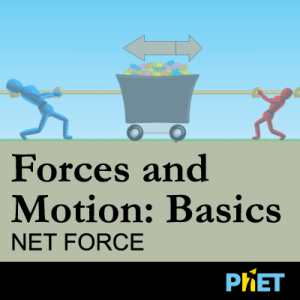
Forces and Motion: Basics - Net Force

Stage a game of tug of war between the red team and the blue team. Add pullers to the rope to increase the force, and discover the relationship between the left force, right force, and net force. Determine if a force is balanced or unbalanced. Note: Students will automatically move through this simulation after 10 minutes of playtime.

Ratings

Teacher Ratings (73) 3.5 stars.

Student Ratings (22731) 3.4 stars.

Activity 7: Simulation Game. Estimated duration: 10 min

Forces and Motion: Basics - Motion

Explore the forces at work when pushing against a refrigerator, crate, or person. Create an applied force and see how it makes objects move. Measure the speed, and learn how to apply a force to speed up or slow down the object. Note: Students will automatically move through this simulation after 10 minutes of playtime.

Ratings

Teacher Ratings (50) 3.6 stars.

Student Ratings (18910) 3.2 stars.

Activity 8: Question Game. Estimated duration: 18 min

Angry Contraptions

This is a physics-based puzzle game where you must collect all the stars on the level. You do this by using Newton's first and second laws to propel three types of balls into the air, but each ball has a different mass. You will have to find a different way to throw each ball. At the end of each level, there is a quiz on the Newton's first and second laws.

Ratings

Teacher Ratings (191) 4.2 stars.

Student Ratings (17934) 3.4 stars.